KEEP PLANNING
time /
space /
about
#031
Perry Ruhland
Directions
(Series of closeups: Black sash for a blindfold knotted tightly behind the head. Wrists and ankles fastened to a chair with straps of ridged leather. Metal gleaming on sharp ninety-degree angles of armrests which squeeze the stomach. Noise-canceling headphones clamped over the ears.
Static, microphone hiss. A voice:)
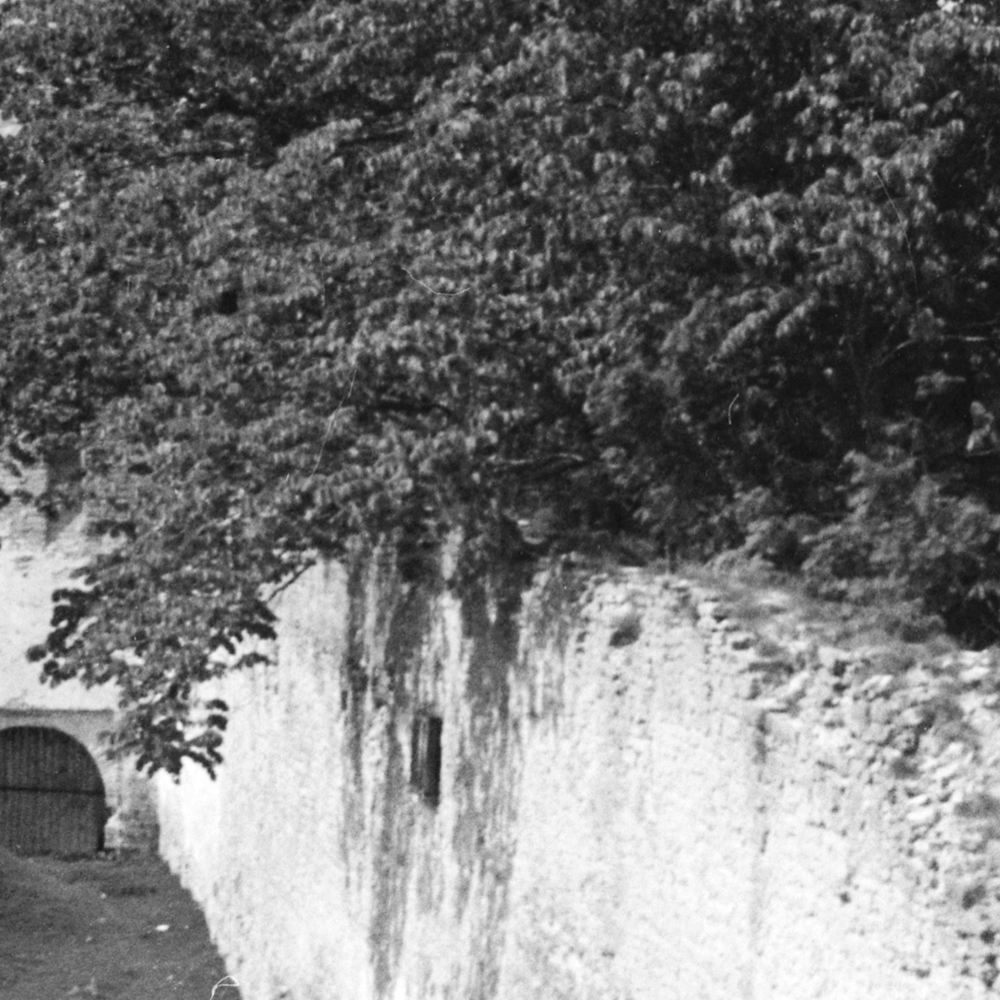
You are in a tunnel. The walls, floor, and ceiling are of uneven stone. The stones which make up the walls form dramatic ridges and outcroppings. The stones which make up the floor are a fine powder. Each stone closest to you contains a rich variety of shades: ash, charcoal, slate, pigeon’s feather, pregnant cloud. Ten feet ahead, these distinct shades become wildfire smoke, and five feet beyond they are a uniform navy, swiftly growing dim, dimmer, and vanishing into darkness. Everything beyond twenty feet is lost in a black oval.
Take one step ahead. You will not be hurt -- the stone is forever damp and smooth beneath your soles. Take a second step. As you do, notice how the black oval retreats by one step, now two. There is no light in the cave, but always you can see twenty feet in front of you. The quality of the dark does not change, but perhaps, if you travel far, the tunnel will.
You walk slowly, with care, head bowed, one open hand pressed against the surface of the cool tunnel wall. The wall is concave, then convex, stone tilting left, right, dimpling beneath your palm. Unseen space melts from the dark, becoming a uniform navy, then wildfire smoke, before dissipating into splotches the color of ash, charcoal, slate, pigeon’s feather, pregnant cloud. Where shades vary, patterns emerge. See the hint of broken triangles, the lopsided figure-eight, the helical veins of whitish rock which begin in a dip besides your right foot and arc up across the wall; they shatter overhead, pale flecks disperse and trail farther across the tunnel before vanishing back into the grays.
The tunnel curves right. The ground, while uneven, has until now been consistent in traveling a horizontal plane. At this righthand turn, you notice a distinct incline. The black oval still hangs twenty feet ahead, but now you face it with your head at a tilt and the ceiling raised.
The black oval changes with every step you take. First the oval was wider than it was tall and pinched at the edges. Gradually those edges smoothed and the sides closed in. The oval is almost a circle, albeit a circle a touch wider than it is tall, and broken in places by blunted outcroppings of rock. The uppermost section of this almost-circle now narrows, becoming tapered at the top while maintaining its width at the bottom. The top inflates; the oval stretches left as if tumbling off its axis; the sides squeeze and you must turn your body to progress. You are still at an incline.
It is only after the ceiling lowers, the top of the oval becoming almost flat, that you reach a plateau. You must crouch for a while, your hand now pressed against the ceiling, damp and smooth like the wall. The space expands by centimeters. When you stand again, it is at an intersection. The black oval is bifurcated by textured stone. It becomes two symmetrical black ovals.
There are two paths ahead. They seem to be identical. Which path will you follow?
You have your voice. Speak.
Left.
You proceed along the lefthand path. The walls, floor, and ceiling are of uneven stone. The stone closest to you holds a rich variety of shades; these shades drain until, twenty feet ahead, they are lost in a black oval. The oval changes with every step you take. The trace of these changes are marked in the shape of advancing ridges and outcroppings. The black oval remains twenty feet before you.
As you progress down this tunnel which is so much like the last, you hear the first trickling of an intramural stream. The sound is weak. It must originate somewhere close behind the leftmost wall. The tunnel bends and curves; the unseen stream bends and curves. As the black oval is always twenty feet ahead, the intramural stream is always somewhere close behind the leftmost wall.
While the black oval distorts with every step you take, these distortions continue to lack a clear pattern or point towards one particular direction. Regardless of any high taperings or dramatic lurches to the left or right, it remains, fundamentally, unchanged. But as you progress along the tunnel, you notice a slight increase in the force and volume of the stream. You walk now with your head tilted so your ear approaches but not quite touches the damp rock of the leftmost wall.
Listen and imagine the path of the stream. Picture a long dark rushing between two jagged shapes. The dark speeds over pronounced mounds, launching up then splashing down. The flow of dark forms bold and violent lines. Imagine black lightning, railway spikes, the tracing of an iguana’s back.
But we have strayed from this tunnel before you. Tell me what you see.
Go on. Tell me.
I am walking down a long tunnel made out of rocks. A black shape is always ahead of me. When I walk, the shape changes. Right now it is a vertical oval. It’s tilted gently at the top. It’s like the mouth in that painting of the man on the bridge. Then it’s like someone hooked three fingers with big, round knuckles in that mouth and pulled at the roof. The top of the oval is almost a triangle. I’m crouched with my left hand on the wall and my head close to hear the stream.
The triangle collapses and it’s like the whole oval deflates. It’s gone horizontal and I’m glad I’m crouched. My back aches from crouching and my knees really hurt. I was told the rocks on the floor won’t hurt my feet, and they don’t. The rush of the water sounds like the blood in my head.
I am at an intersection, one tunnel goes left and one tunnel goes right. I went left last time so now I go right. The shape here is wider and less like an oval. I stand up straight. The walls are splotched dark and light. I don’t need to press my head against the left wall because I can hear the intramural stream just fine. I see the dark rushing over a riverbed of black rocks and large, dead bugs.
The path is an uphill incline. It becomes the steepest incline I have ever walked. To take little steps I must raise my knees up to my chest. I keep a hand against a wall for support. The shades in the walls form patterns. The dark shape pulses.
The dark struggles against the confine of the shape.
It tears new angles from the rock.
I hear the intramural stream behind the lefthand wall, and now machinery, churning gears, electric snaps and hums behind the righthand wall.
Sweat is on my back and my neck. I can feel it in my hairs.
My right shoulder is stiff and aching.
Walking through the imprints of past ovals is like walking through the rings of a tree.
The air is neither hot nor cold, and very still.
The wall is full with marks and glyphs.
My hand pressed against the wall is wet.
Now I’m afraid of slicing my palm on jutting rock and am shocked I haven’t already.
The tunnel lurches right.
The dark shape narrows.
It disappears.
I am paces from the end of the tunnel. There is a flat rock wall and a door in the wall. The door is of thick, grey metal, dotted with carbuncles of rust. It is slightly taller than my body and a little wider too. It has a grey metal handle, like a lever. I take my hand off the wall and grip the handle. It’s sticky beneath my palm.
On one side I hear the rushing water and on the other side I hear the machines. Behind the door I hear nothing.
I open the door.
I step out to concrete and an overcast sky. The air stinks of something, chlorine. There’s a kidney-shaped pool in front of me, and nobody is swimming, and dark clouds are reflected in the surface of the pool. Besides the pool I see a circular jacuzzi, and between pool and jacuzzi, a concrete bungalow with toilets and showers. All of this is surrounded by metal fencing. I do not need to look to know the streets and houses beyond the fence. This is the community pool in which I once came to swim. I stand inside the townhome community where I grew up.
I walk across the poolside. The day is quiet and neither hot nor cold. Through the bars of the fence I see that all of the demarcated parkings spaces are empty. I pass through the gate and a row of white stucco pillars to reach the street. The townhome community’s streets are long and curving. They are named after classical musicians. Webern is lined with grass, beige stones, and trees. There are filigreed streetlamps, which are lit, and yellow lights warble in the air. I see beige townhouses, three stories tall and five units a piece. Each unit has a gated porch decorated with windchimes and other sundries. I try peeking into windows, dark and shuttered.
I turn from one curved street onto another. Alongside some townhouses are sets of green boxes with yellow signs warning DANGER: ELECTRICITY. There is a basketball court. There is a bank of metal mailboxes. There are rows of white garage doors. There are no cars in the streets. The tip of a palm tree pokes behind a roof.
My childhood home is the last unit on this street. There are four units I walk past. From one, I catch the stink of a cigarette discarded in a stony lawn. The gate to my childhood home is opened by a latch and there is a table and a barbeque on the porch. Both are covered in dust and leaves. A cobweb hangs on the leg of a metal chair. I have the key to the house in my pocket. I have pockets.
I unlock the door and I step inside.
The inside of my childhood townhouse is a square room. The walls are grey, the floor is grey, the acoustic tile ceiling is grey. There is a large hissing cube next to me with dials, levers, and ports for auxiliary cables. Some of these ports are filled and cables spread across the floor.
One cable leads to a microphone on a stand. Other cables lead towards a chair. The chair is made of metal slabs which meet at sharp ninety-degree angles. Black ovals dangle from the front legs and the armrests. The cables snake up the side of the chair and feed into a pair of bulky headphones.
There is nothing else in the room. I would leave but there is not even a door.
I think I’ve had enough.
Really, I’m done. No more, please. I don’t want to be here.
Please.
You’ve made your point.
***
Perry Ruhland is a writer based in Chicago. His writing has previously been published in minor literature[s], Vastarien Magazine, Weird Horror Magazine, and ergot.press. Learn more at perryruhland.com.
4 February 2026